The modern crisis of knowing
We live in an age overflowing with information—and starving for clarity.
Facts and figures are at our fingertips. Expert opinions, scientific studies, political claims, spiritual teachings, and endless streams of commentary bombard us daily. And yet, instead of producing certainty, this glut of information often breeds confusion, division, and distrust.
The problem is not simply a lack of data, but a lack of epistemology—a way of determining how knowledge is established, evaluated, and trusted. Information is plentiful, but without a framework to sift truth from illusion, the modern seeker is left adrift.
This is where the Bhāgavata tradition offers something vital: not just content, but a method of knowing.
What is epistemology?
Epistemology is the study of how we know what we know. Every claim to truth—whether in science, philosophy, or spirituality—rests on assumptions about valid sources of knowledge.
Western philosophy has long debated whether knowledge is rooted in sense perception, rational inference, or empirical testing. Each school of thought champions one source while questioning the others.
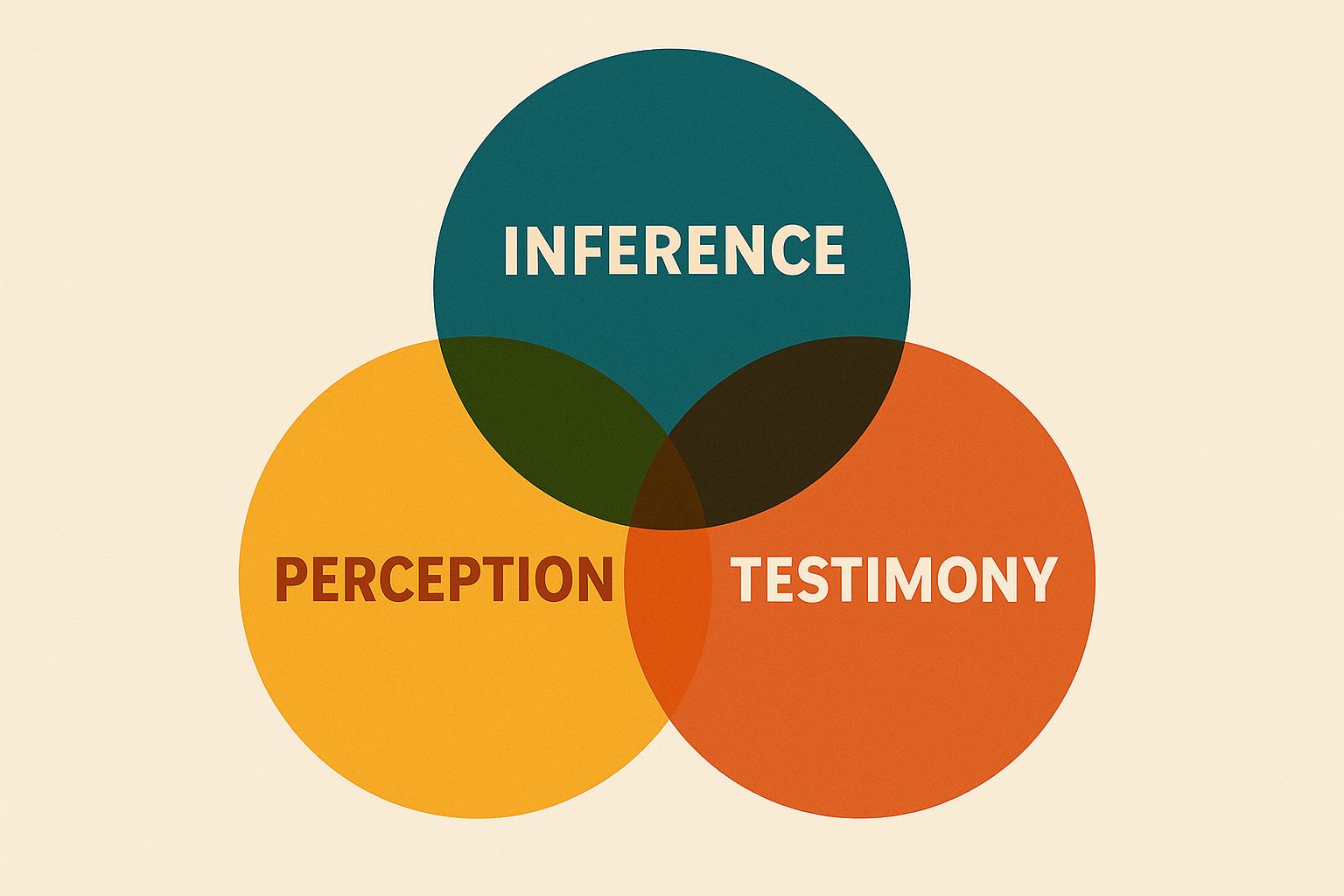
The Bhāgavata tradition, however, offers an integrated model. It accepts multiple sources of knowledge, acknowledging their strengths while also recognizing their limitations. This approach is codified in the concept of the three pramāṇas—valid means of knowledge.
The three Pramāṇas in Bhāgavata Philosophy
Pratyakṣa – Direct Perception
Perception is our most immediate way of knowing. We see, hear, taste, touch, and smell, and these impressions form the raw data of experience. Both daily life and empirical science rely heavily on this foundation.
Yet perception is limited. Our senses operate within narrow bands of frequency; they are easily deceived and often incomplete. A stick half-submerged in water appears bent. The sun looks small to the naked eye though it dwarfs the Earth.
The Bhāgavata tradition recognizes perception’s value but urges refinement—through careful observation, extended instruments, and humility about its limits.
Anumāna – Logical Inference
Inference allows us to move from evidence to conclusion. “Where there is smoke, there is fire.” Reasoning builds scientific theories, philosophical systems, and ethical codes.
But logic, too, has its boundaries. A syllogism is only as strong as its premises. Faulty data, unexamined biases, or limited perspective can render the most elegant reasoning invalid. As the Bhāgavata warns, reason alone is a map, not the territory.
Śabda – Authoritative Testimony
The third pramāṇa—śabda—is both distinctive and indispensable. It refers to knowledge passed down from realized sources, specifically the revealed wisdom of scripture and the testimony of enlightened teachers.
In modern life, we rely on testimony constantly—teachers, mentors, scientific papers, or news reports. The Bhāgavata tradition refines this by asking: Is the source realized? Is it consistent? Is it free from selfish motive?
The Śrīmad-Bhāgavatam itself is described as parama-haṁsa-saṁhitā—the mature fruit of Vedic wisdom, spoken by realized sages and preserved in paramparā (disciplic succession). For the seeker, śabda is not blind belief but reasoned trust in a living transmission of wisdom.
Paramparā: knowledge as living transmission
The Bhāgavata system places special emphasis on paramparā, the lineage of teachers through whom knowledge is preserved and embodied. Teachers in this tradition are not mere lecturers; they are ācāryas—those who teach by example. Their character validates their words.
In an age where misinformation and manipulation erode public trust, this model is striking. The Bhāgavata insists: real knowledge is inseparable from the integrity of the knower. Testimony gains validity not from charisma or authority but from alignment with truth, humility, and realization.
Thus, knowledge is not just transmitted—it is lived.
A balanced spiritual science
Bhāgavata epistemology does not ask seekers to abandon reason or evidence. Instead, it provides a balanced framework where perception, inference, and testimony work together:
- Pratyakṣa grounds us in lived reality.
- Anumāna allows us to interpret and extend it.
- Śabda anchors both in the wisdom of realized beings and scripture.
Each pramāṇa supports the others. Perception without reasoning is raw; reasoning without testimony risks arrogance; testimony without perception and reasoning can devolve into dogma. When integrated, they form a holistic epistemology—an approach that embraces both the outer and inner sciences.
This is especially relevant today, when many seekers feel caught between skepticism and spirituality. Scientific training conditions us to value evidence; spiritual yearning drives us toward transcendence. The Bhāgavata model bridges the two, offering a spiritual science that honors both.
Why modern seekers need this
In today’s fractured landscape, everyone has data, logic, and confidence. Competing voices claim authority, and seekers are left asking: Who is trustworthy?
Bhāgavata epistemology provides a solution:
- Value perception, but don’t absolutize it.
- Use reason, but recognize its limits.
- Honor tradition, but only when embodied by realized souls.
This method does not just identify truth abstractly—it shapes character. It cultivates humility, discernment, and reverence for wisdom. In this way, epistemology becomes more than a theory; it becomes a path of transformation.
Knowing as transformation
In an era drowning in information yet parched for clarity, the Bhāgavata tradition offers a lifeline. Its epistemology provides seekers with a way to evaluate claims, discern truth, and anchor knowledge in lived realization.
True knowledge, it insists, is not merely accurate—it is transformative. It reshapes how we live, how we relate, and how we seek the ultimate purpose of existence.
To know in the Bhāgavata sense is not only to collect facts, but to awaken wisdom—to see clearly, live truthfully, and reconnect with the eternal self.
For modern seekers, this is not just philosophy. It is guidance for navigating a fractured world with depth, discipline, and devotion.