Consciousness as fundamental
The Atma Paradigm begins from a decisive axiom: consciousness is a fundamental property of reality. It is not reducible to physical structures nor adequately explained by material processes. While future physics may uncover new layers that clarify its mechanisms, the most fruitful path forward is to treat consciousness as a primary phenomenon in its own right.
This perspective addresses long-standing anomalies: the irreducible qualities of experience (qualia) and the enduring unity of the self. Where physicalism treats consciousness as an illusion or a byproduct of the brain, the Atma Paradigm places the experiencer at the very heart of reality.
The Atma and the structure of life
At the core of this paradigm is the atma—the conscious self, the irreducible subject of awareness. The atma experiences through the mind and body but is not identical with them nor “is made” by them. Just as a gamer becomes absorbed in a virtual avatar, the atma identifies with its body and mind, while in truth remaining distinct.
This model preserves neuroscience as a study of the correlations between brain activity and experience, but it expands the framework: the brain processes data, the subtle mind translates it into qualia, and the atma observes. Consciousness thus complements, rather than competes with, scientific findings.
From biology to cosmology
The Atma Paradigm also reframes biology and cosmology. DNA is not a rigid master code but a tool through which life responds dynamically to consciousness and environment. Intention—individual and collective—becomes a causal factor in evolution, a possibility hinted at by decades of experimental research on mind-matter interaction.
Cosmology, too, takes on new significance. Rather than arising from chance, the universe is conceived as participatory: matter and information emerge in dialogue with conscious agents. Consciousness is not an accidental latecomer but integral and pre-existing to the unfolding of physical reality.
Meaning, purpose, and the human condition
Perhaps most importantly, the Atma Paradigm restores a sense of human meaning. Instead of viewing ourselves as biochemical accidents produced by blind random processes, we recognize ourselves as conscious agents with free will and purpose. Consciousness is not a negligible byproduct of matter but a co-creator in reality’s unfolding.
This has profound consequences for the human condition. Many crises of modern society—existential despair, alienation, and the reduction of human life to mechanistic functions—arise from a worldview that denies intrinsic meaning. By acknowledging consciousness and purpose as fundamental, we open a path toward psychological well-being, social renewal, and ecological responsibility.
The Bhāgavata Philosophy and metaphysical framework
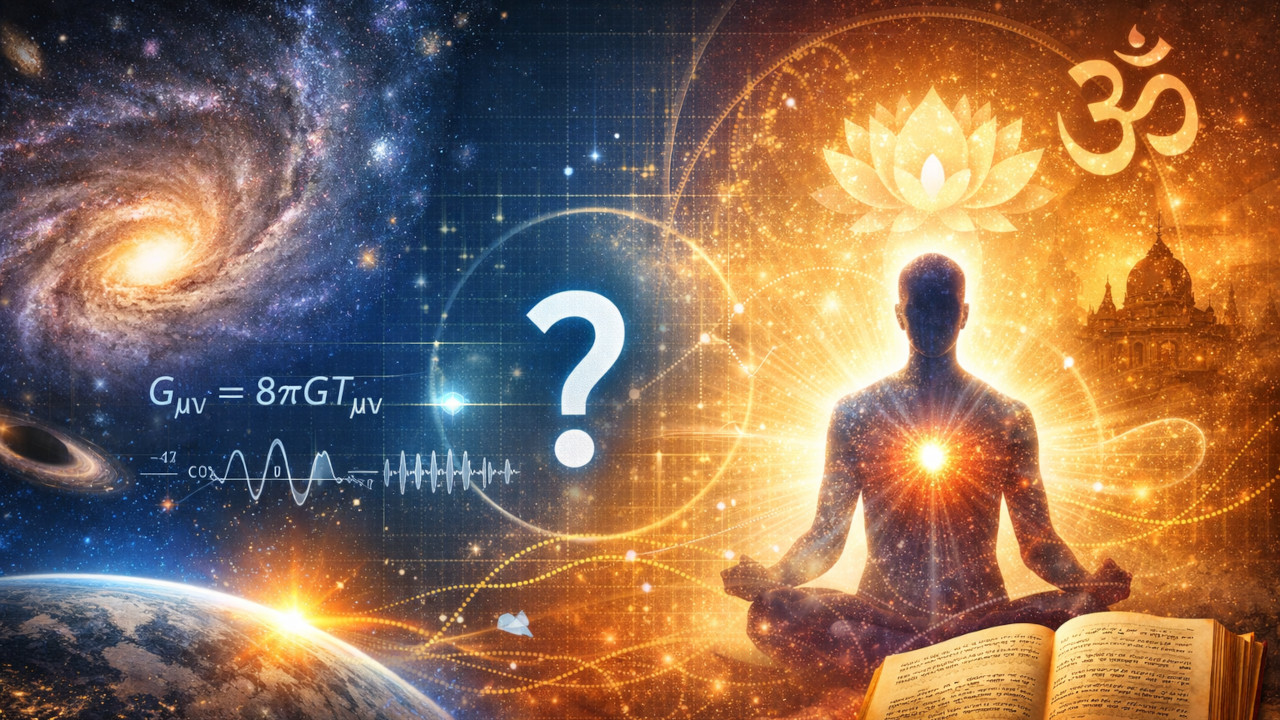
The Atma Paradigm aligns closely with the Bhāgavata philosophical tradition, which emphasizes the primacy of consciousness as Sat meaning eternal or ever-existing, Cit meaning full of knowledge and awareness, and Ananda means bliss or great contentment. In this framework, the atma is an eternal self, distinct from but engaged with the physical world.
The Bhāgavata view enriches the Atma Paradigm in three ways:
- Ontological clarity: Reality is composed of consciousness, matter, and the supreme source of both.
- Teleology: Life is purposeful, directed not only by survival but by the pursuit of higher meaning and realization.
- Ethics and compassion: If every being is a conscious atma inhabiting a body, then respect for life becomes a natural ethical imperative.
This metaphysical framework offers an effective “cure” for the diseases of modernity: nihilism, consumerism, and the loss of shared values. It grounds human existence in purpose and dignity, harmonizing reason with timeless wisdom traditions.
An invitation to inquiry
The Atma Paradigm does not discard the achievements of science; it extends them. By treating consciousness as fundamental, it reframes neuroscience, biology, and cosmology, while opening a richer inquiry into meaning, ethics, and purpose.
In essence, it is an invitation—to science, philosophy, and culture—to move beyond reductionism and to recognize consciousness as central to reality. By doing so, it unites empirical evidence with lived experience, offering a vision in which curiosity, creativity, and compassion are not accidental, but essential to who we are.