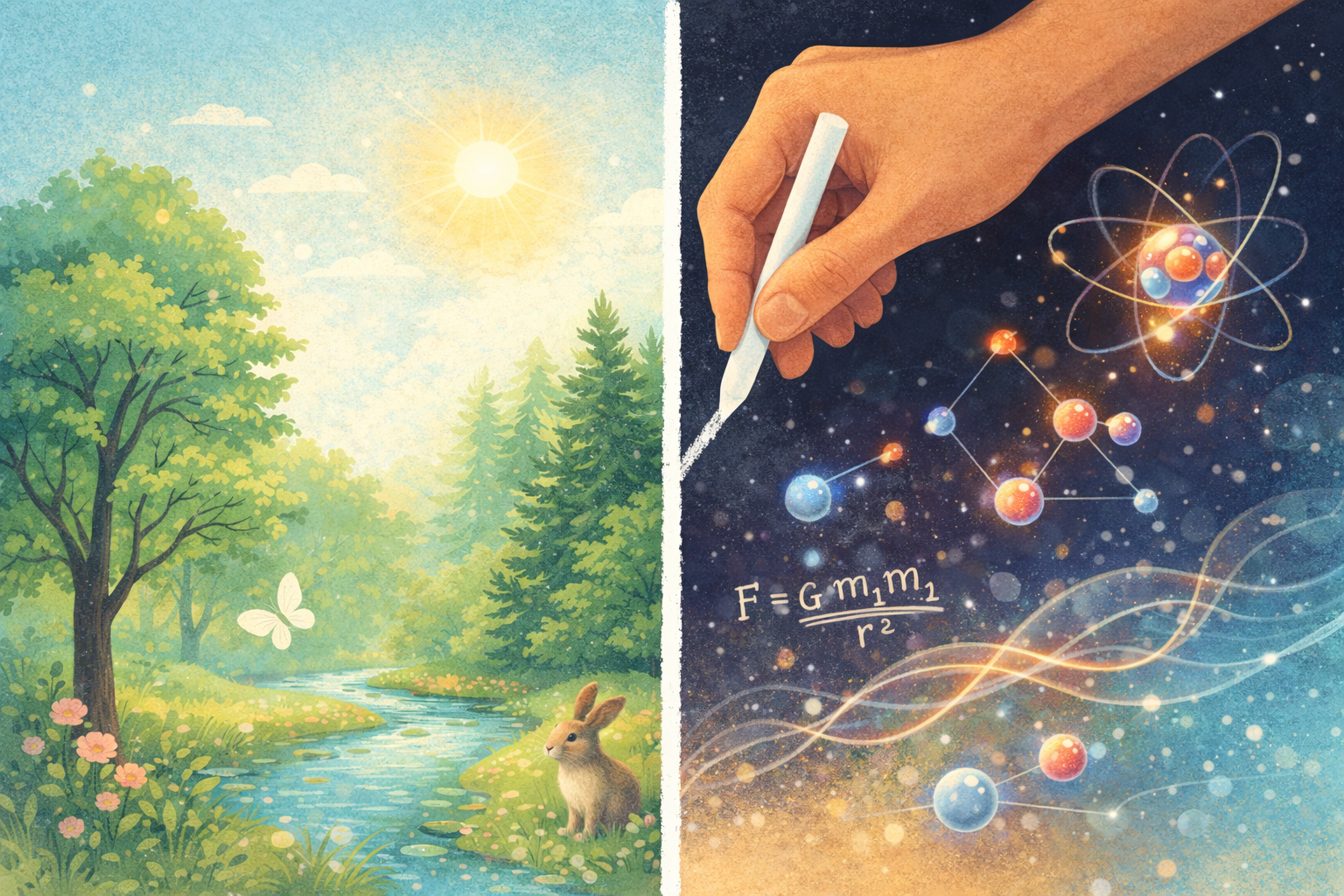
For all its remarkable successes, modern physics has reached a curious juncture. We can calculate the paths of particles to astonishing precision. We can model the birth of the universe with equations that fit the data to the limits of our instruments. We can even map the cosmic web stretching across billions of light-years. And yet, the very concepts on which these triumphs rest—space, time, causality, even the notion of an “event”—are now under question.
Is space a fundamental arena, or something that emerges from deeper patterns? Is time a smooth continuum, or a constructed artifact of relations? Is the universe deterministic, probabilistic, or something else altogether—something beyond either? These are not idle speculations from the fringes of philosophy. They are central, pressing questions at the frontier of physics itself.
The limits of empiricism
For all its predictive power, the great machine of empirical discovery seems to be slowing. The monumental successes of the twentieth century—relativity, quantum mechanics, the Standard Model—now stand like towering peaks, their summits mapped, their trails well-worn. Beyond them, the terrain becomes uncertain. Enormous intellectual and financial investments in supersymmetry, string theory, and quantum gravity have produced beautiful mathematics, but few definitive experimental confirmations. The sheer complexity of the formalism sometimes seems to obscure, rather than illuminate, the underlying nature of reality.
Behind every model lies a metaphysics—a set of assumptions about what exists and how it exists. Yet, in modern science, those assumptions are often implicit, taken for granted, and seldom examined. Perhaps it is time to pause and look again, not merely at the data, but at the frame within which the data appears. The call is not to abandon physics, but to deepen it—to return to its philosophical roots, where questions of being and relation were once inseparable from questions of measure and motion.
From objects to relations
Across quantum mechanics, relativity, information theory, and new approaches to geometry, a subtle shift is taking place. The dominant metaphors of twentieth-century physics—particles moving in space, forces acting across a void, fields filling a static background—are giving way to new metaphors: topological, informational, algebraic.
Where once we asked, “What are the fundamental particles? What forces act between them? What is spacetime made of?”—the frontier questions are changing. Now we ask, “What relational structures give rise to what we perceive as geometry? How do interactions define the very entities that interact? What is the minimal structure required for observation itself to occur?” These are not merely technical puzzles. They are ontological shifts. They suggest that the universe may not be made of things at all, but of relations and distinctions—patterns of coherence emerging from the interplay of difference.
The grammar of physics is shifting: from nouns to verbs, from substance to syntax, from position to pattern. The very idea of a “thing” may be giving way to the notion of process, interaction, and mutual definition. In this way, physics is rediscovering what many philosophical traditions have long maintained: that reality is not a collection of independent entities, but a web of interdependent relations.
Echoes of ancient thought
This relational turn has deep philosophical echoes. In the metaphysical traditions of both East and West, thinkers have long emphasized the primacy of relation over substance, of becoming over being. In the Vedic and Buddhist traditions, for instance, the world is seen not as a collection of fixed entities but as a living process of differentiation and integration—a rhythm of manifestation and withdrawal. Similarly, in the Western lineage, philosophers from Heraclitus to Whitehead have proposed that reality is constituted by processes, events, and patterns of interaction, rather than inert matter.
Modern physics, in its most abstract form, seems to be converging upon these ancient intuitions. The fabric of spacetime, once thought to be the immutable stage upon which events unfold, now appears to arise from quantum entanglement, information exchange, or other forms of relational coherence. The physical world may not be built from “stuff” at all, but from the logic of relations—the very grammar of interaction that underlies both matter and mind.
The reemergence of metaphysics
To speak of metaphysics in the age of physics is not to regress into speculation. It is to recognize that physics itself is, and always has been, built upon metaphysical assumptions—about what is real, what can be known, and how being and knowing are related. When we question these assumptions consciously, rather than unconsciously, we open new vistas for discovery.
The synthesis of physics and metaphysics need not be mystical. It can be rigorous, clear, and empirical in spirit, while also expansive in scope. Relational models—mathematical, informational, or experiential—can serve as a bridge, offering a playground where themes of emergence, coherence, and transformation can be explored in both quantitative and qualitative terms. When relations become sufficiently layered and coherent, new regularities appear: as harmony emerges from overlapping tones, or as geometry arises from patterns of distinction. These are not poetic analogies but clues to a deeper architecture of reality.
Toward a new understanding of reality
The story of physics is still being written. But its recent chapters hint at a turning point—a moment when metaphysical insight and mathematical sophistication may begin to converge. In this emerging view, the universe is not a machine built from parts, governed by external forces. It is a living, unfolding text—a dynamic web of relations whose meaning arises through participation and cannot be made complete by any final theory.
If this is so, then the next revolution in physics will not merely extend our equations; it will deepen our understanding of what equations represent. Science will not lose its rigor but gain a new dimension of meaning. The boundary between physics and metaphysics will dissolve—not through confusion, but through clarity.
And perhaps then, physics and philosophy will meet again where they began: at the heart of wonder, in the shared intuition that to know the world is also to participate in it.