PUBLICATION

A Universe from Nowhere: Finite Euclidean Time and the Ontology of Spacetime

Abstract
A new framework links Euclidean and Lorentzian physics, showing how time, space, and causality can emerge from a timeless pre-geometric phase.

The paper describes a way of building a quantum field theory that begins in a “Euclidean” form—one that uses imaginary time and has no distinction between time and space—and then smoothly transitions into the familiar “Lorentzian” version that operates in real time, like the universe we experience. This approach works on a cosmological background similar to the expanding universe described by the Friedmann–Robertson–Walker model.

In this setup, a finite “Euclidean cap” can reproduce what’s known as the Hartle–Hawking “no-boundary” proposal, a model suggesting the universe had no sharp beginning in time. The mathematical conditions called reflection positivity and analytic continuation ensure that when the theory shifts from imaginary to real time, it produces exactly the same physical behavior we expect in ordinary spacetime.

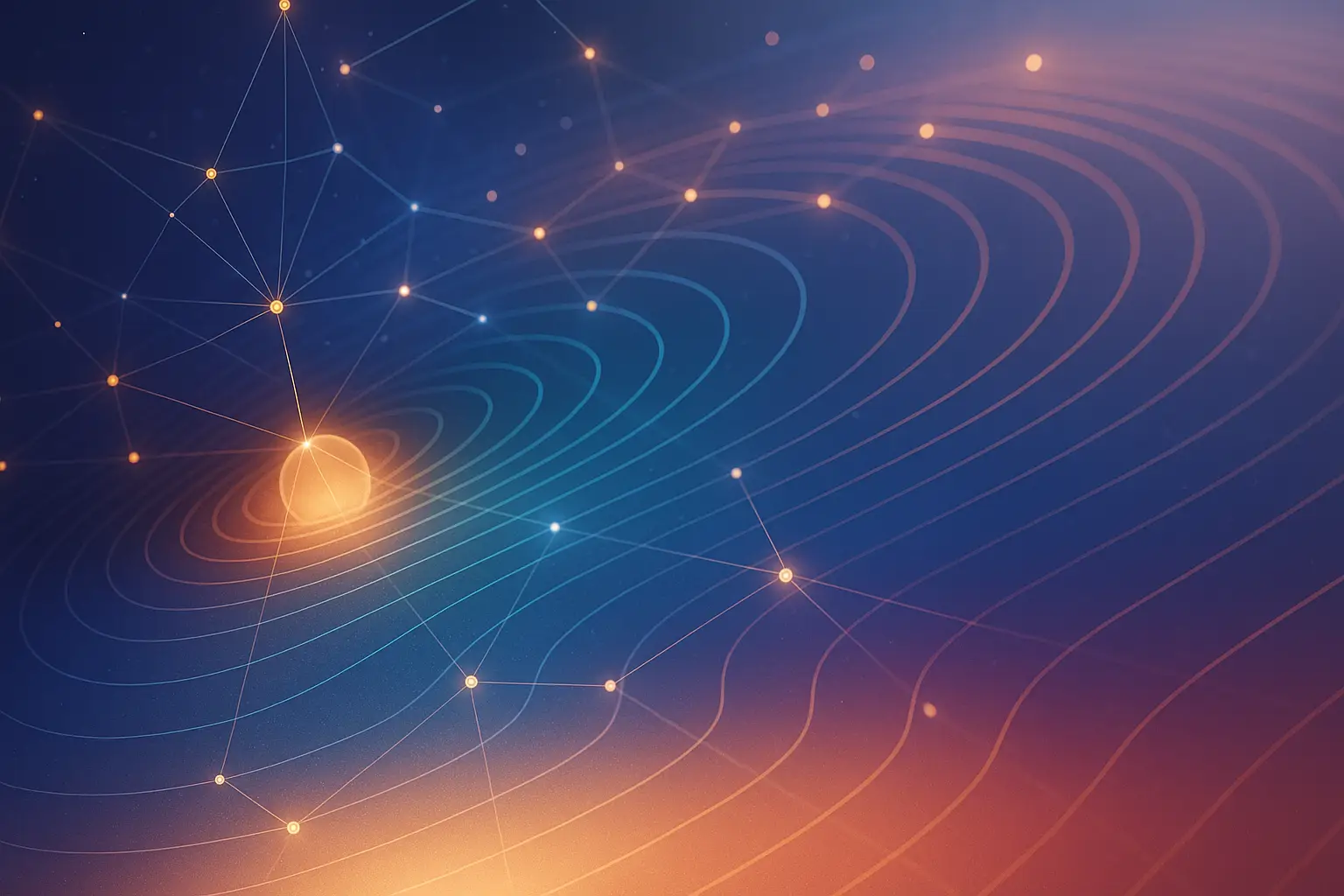
More broadly, this framework applies to any Euclidean system that can be converted in this way, providing a consistent way to describe cosmologies that begin with special boundary conditions. In this picture, the Euclidean phase represents a kind of timeless, pre-geometric state with extremely weak spatial connections. Ordinary space, time, and causality emerge only when the system transitions into the Lorentzian phase.

Importantly, this process keeps all the physical features—vacuum state, mathematical consistency, and classical behavior—the same as in standard cosmology. The result is conceptually intriguing: multiple mathematical descriptions can predict the same universe, but with very different philosophical interpretations of what “time” and “space” fundamentally mean.

Download the PDF: link

Share the Post
FROM THE BLOG
KNOWING
Tiziano Valentinuzzi

What science can and cannot explain

Science powerfully describes how the universe behaves, but it remains silent on deeper questions of meaning, consciousness, and purpose. Drawing on examples from cosmology and quantum mechanics, this article explores the limits of scientific explanation and the role of the observer in knowledge itself. Through the lens of the Ātma Paradigm and Bhāgavata philosophy, it argues that consciousness is not a byproduct of matter, but the foundation that makes reality and understanding possible.

Read More »
NEWS
Doug Watson

Does the Universe Need an Observer?

How can a universe exist without any observer within it? A new paradox in modern physics suggests that a fully observer-free cosmos may collapse into a single informational state, and that complexity returns only when reality is described from a standpoint inside it, echoing the Vedic triad of knower, known, and knowing.

Read More »
NEWS
Doug Watson

How to Detect Consciousness in People, Animals and Maybe Even AI

How do we truly know if someone—or something—is conscious? This question ranges from unresponsive humans to potential AI awareness. Recent neuroimaging advancements suggest consciousness may extend beyond outward behavior. Can we ever fully grasp consciousness, or are we limited by our biases and tools?

Read More »

Join the WhatsApp Group

Stay connected with a growing community of thoughtful seekers. Be the first to know when we publish new articles, videos, podcasts, or host live webinars. One message, zero spam—just timely updates to support your journey into deeper clarity, purpose, and connection.