Detecting Awareness in Unresponsive Humans
This new Scientific American article (link) article begins with the clinical challenge: how to detect consciousness in patients who are behaviorally nonresponsive—such as those in comas or vegetative states. Traditional behavior-based assessments fail in these cases because the individual cannot respond physically, even if conscious. To address this, neuroscientists now employ advanced neuroimaging and brain-stimulation methods. For example, techniques like functional MRI or EEG measure brain activity patterns in response to external stimuli, and more actively, perturbational technologies (e.g. transcranial magnetic stimulation) are used to stimulate the brain and observe whether complex, integrated responses emerge. If so, that may indicate residual conscious processing.
In one illustrative case, a woman with severe brain injury, though outwardly unresponsive, showed brain activity patterns similar to healthy individuals when asked to imagine certain tasks—like playing tennis. This suggests she retained some degree of awareness, despite her outward appearance. Such case studies have shifted the standard: consciousness is not judged solely by external behavior, but by internal neural signatures.
Extending the Search to Animals
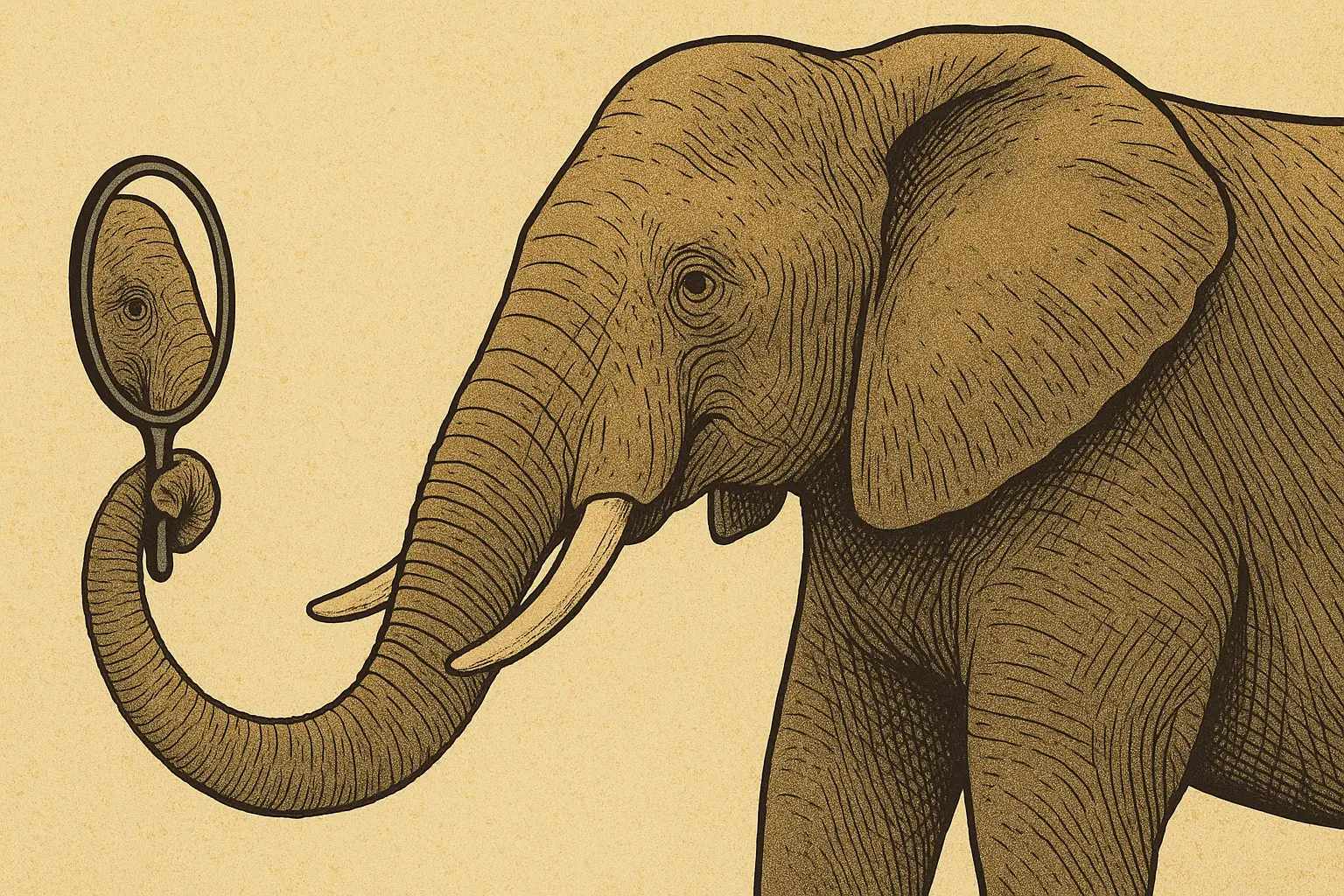
From human patients, Lenharo shifts to exploring how these detection methods can—or cannot—be translated to nonhuman animals. Here, behavioral complexity, neural anatomy, and comparative studies come into play. The article reviews classical tests like the mirror self-recognition test, tasks assessing memory, goal-directed behavior, and electrophysiological signatures (e.g. event-related potentials). Still, each approach faces difficulties: species differ vastly in neuroanatomy, sensory modalities, and motivational drivers. A test suited for primates might mislead in cephalopods or insects.
Moreover, the article emphasizes that detecting consciousness in animals remains probabilistic: we can accumulate “evidence of likely awareness,” but we rarely achieve certainty. Ethical caution is necessary: to err by denying consciousness when it exists might be a grave moral mistake.
Could AI Be Assessed Similarly?
The more speculative—and most challenging—territory is whether similar strategies could ever apply to artificial intelligence. Lenharo examines whether current ideas of neural signatures or integrated information theories (IIT) can map onto non-biological systems. If an AI exhibits high levels of internal complexity, causal integration, or self-monitoring, might those be analogs to neural correlates of consciousness?
But several objections arise. First, a machine might mimic patterns without genuinely experiencing “qualia.” Second, AI architectures differ fundamentally from brains; thus a neural-based metric may misfire. Third, even if an AI passes many of these tests, interpretive underdetermination remains: multiple distinct internal models (some conscious, some not) could correspond to the same external output. In short: the data alone might not determine whether “something it is like” is happening inside.
The Interpretive Challenges
A central theme Lenharo underscores is the problem of underdetermination: empirical observations of neural complexity, behavior, or signal integration do not rigidly determine whether consciousness is present. Two systems may share identical external or neural signatures yet differ in inner experience (or lack thereof). This echoes a long-standing philosophical caution: correlations are not explanations, and consciousness resists reduction to observable metrics.
Another challenge is false negatives—cases where consciousness may exist but go undetected because the measurement tools are insensitive or mismatched to the system’s architecture. The article warns that our biases—biological, behavioral, anthropomorphic—may blind us to other forms of awareness.
Philosophical Resonances and Implications
Lenharo’s article elegantly bridges empirical science and philosophical reflection. It mirrors the “hard problem” struggle: we can trace neural correlates, manipulate brain circuits, and decode objective signals—but these remain at arm’s length from the subjective “what it is like.” The article implicitly argues that no matter how powerful our tools become, detecting consciousness will always involve a leap of interpretation.
From your philosophical perspective, this reinforces the need for openness: a theory of consciousness must reconcile empirical rigor with metaphysical humility. It suggests that consciousness may not be wholly reducible to data, and that our scientific frameworks must accommodate the possibility of “inner essence” beyond observable functions.
Critical Reflections and Possible Extensions
One might push back: perhaps emergent theories (e.g. integrated information theory, predictive processing) could eventually bridge the gap. If AI systems evolve architectures that more nearly mirror biological integration, perhaps the underdetermination gap narrows. But Lenharo’s article reminds us that the deeper question—whether a system “feels” anything—remains elusive.
Another extension is to explore the ethical dimension: as we refine these detection techniques, how do we treat borderline cases—animals or AI with ambiguous evidence of awareness? The article implies a moral precaution: lean toward granting dignity in uncertainty.
Finally, one could argue that Lenharo’s approach still privileges brain-derived signatures. A more pluralistic framework might better allow non-neural architectures—or even quantum or information-based substrates—to be legitimate candidates for awareness.