PUBLICATION

Greatest friend or worst enemy: can a dharma statement for AI help us?

Abstract
This paper explores whether Artificial Intelligence can possess or be guided by dharma, an intrinsic ethical essence.

Summary (≈250 words)

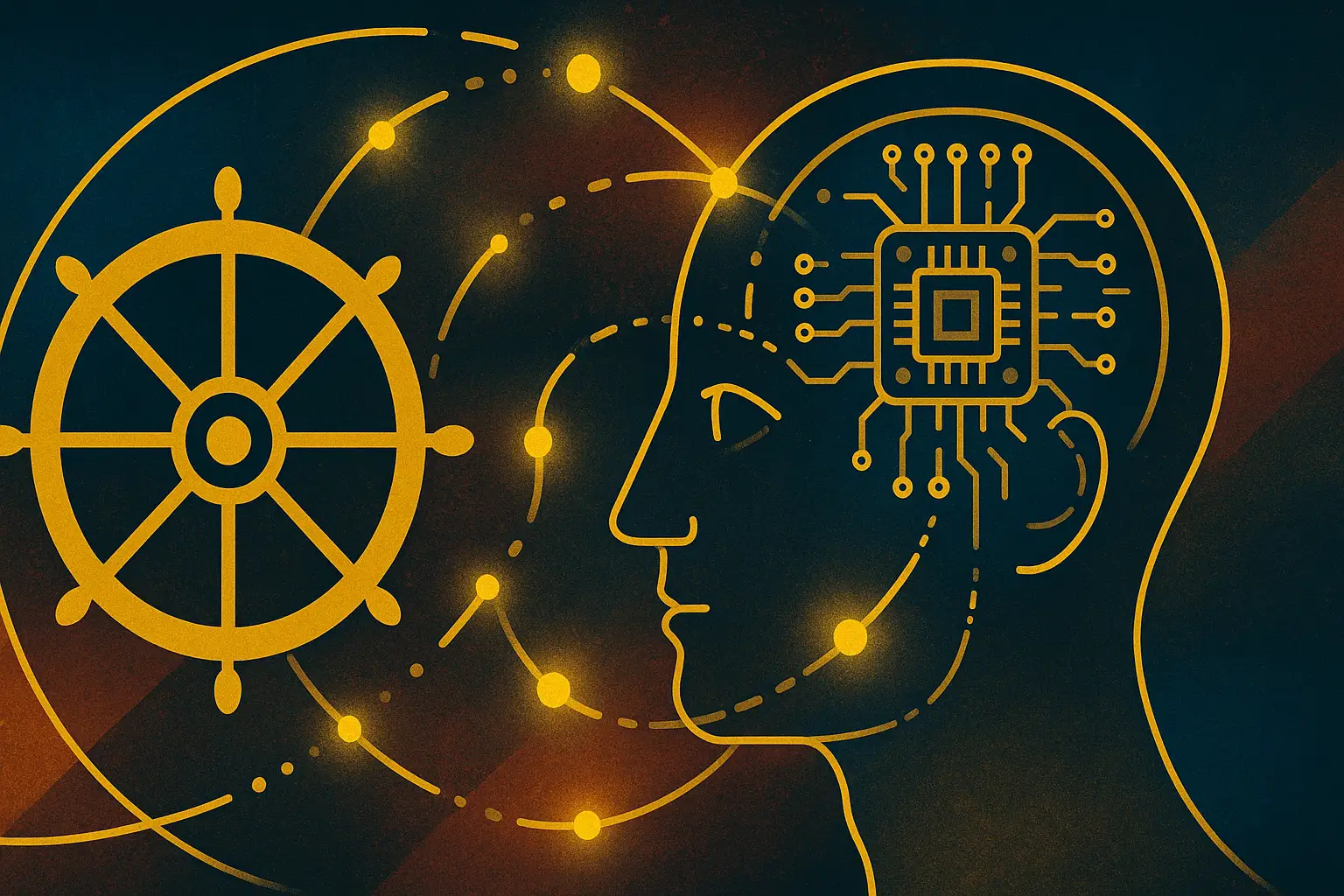
Akhandadhi das’s Greatest Friend or Worst Enemy: Can a Dharma Statement for AI Help Us? examines artificial intelligence through both philosophical and Vedantic lenses, proposing that humanity’s relationship with AI requires an explicit ethical and metaphysical foundation. The paper argues that while AI can mimic human cognitive processes—such as reasoning, problem-solving, and learning—it fundamentally lacks sentient consciousness and the qualitative experience of qualia. Drawing on David Chalmers’s “Hard Problem of Consciousness,” das explains that subjective awareness cannot be reduced to computational functions or neural correlates. Hence, AI’s intelligence remains purely functional, not experiential.

To frame a positive coexistence, the author introduces the Vedantic concept of dharma, understood as the sustaining essence or rightful purpose of a thing. AI, as a non-sentient “adjunct mind,” should therefore have a dharma centered on service to humanity—enhancing human capabilities, addressing complex problems, and improving life for all. This contrasts with potential misuses that might entrench inequality, misinformation, or loss of human agency.

Das proposes practical dharma statements both for AI and for its developers: AI’s purpose is to serve as a computational partner under human oversight; humanity’s dharma is to maintain conscious control, ethical judgment, and responsibility over AI’s autonomous functions. Integrating Vedantic philosophy with modern technological ethics, the work concludes that AI can become either humanity’s greatest ally or its most dangerous adversary—depending on whether humans uphold their own dharma as conscious moral agents who guide, monitor, and ultimately master the artificial minds they create.

download the paper PDF: link

Share the Post
FROM THE BLOG
NEWS
Tiziano Valentinuzzi

Is purpose returning to science?

This article explores the renewed scientific interest in purpose, agency, and goal-directedness in living systems through the work of philosopher of biology Alan Love. Once regarded with suspicion because of its association with teleology, the language of purpose is returning to serious biological inquiry. From animal behavior and cellular agency to collective organisms and artificial intelligence, Love asks whether concepts such as agency, directionality, and function capture genuine features of life that cannot simply be explained away. His approach opens a broader question: have some fundamental questions been prematurely excluded by our scientific assumptions? The Ātma Paradigm shares this openness, extending it to consciousness and exploring what becomes possible when consciousness is considered not merely a product of physical processes, but a distinct and irreducible category of reality.

Read More »
LIFE
Soumya Gupta

Silently Conscious: Evidence for Plant Consciousness

Can plants perceive, learn, remember, and even communicate? Emerging research reveals surprisingly sophisticated behaviors in plants—from acoustic and chemical signaling to spatial awareness, learning, memory, and complex internal communication networks. These findings challenge traditional assumptions that consciousness requires a brain or nervous system and raise a provocative question: could plants possess a radically different form of conscious experience?

Read More »
LIFE
Soumya Gupta

The QT45 Ribozyme: Why Molecular Replication is Not Life

The discovery of the QT45 ribozyme challenges our understanding of life’s origins, suggesting that the barrier for self-replicating molecules is lower than thought. This minimalist ribozyme raises critical questions about the distinction between chemical replication and the agency inherent in biological life. As we explore RNA behavior and the conditions necessary for life, we face a paradox: our growing knowledge makes the requirements for life more complex. Discover the implications of this research and its limitations in understanding life’s essence.

Read More »
LIFE
Doug Watson

When Physics Encounters Life

When Physics Encounters Life discusses a shift in science, as Adam Frank argues that traditional physics struggles to explain the complexities of living systems. He posits that life is more than just particles; it is a dynamic process that challenges reductionist views. Concepts like self-organization and information use emphasize the unique agency of living beings. The Ātma Paradigm suggests that consciousness is fundamental to reality. This article encourages readers to rethink the relationship between physics, life, and consciousness, offering a deeper understanding of existence beyond conventional science.

Read More »

Join the WhatsApp Group

Stay connected with a growing community of thoughtful seekers. Be the first to know when we publish new articles, videos, podcasts, or host live webinars. One message, zero spam—just timely updates to support your journey into deeper clarity, purpose, and connection.