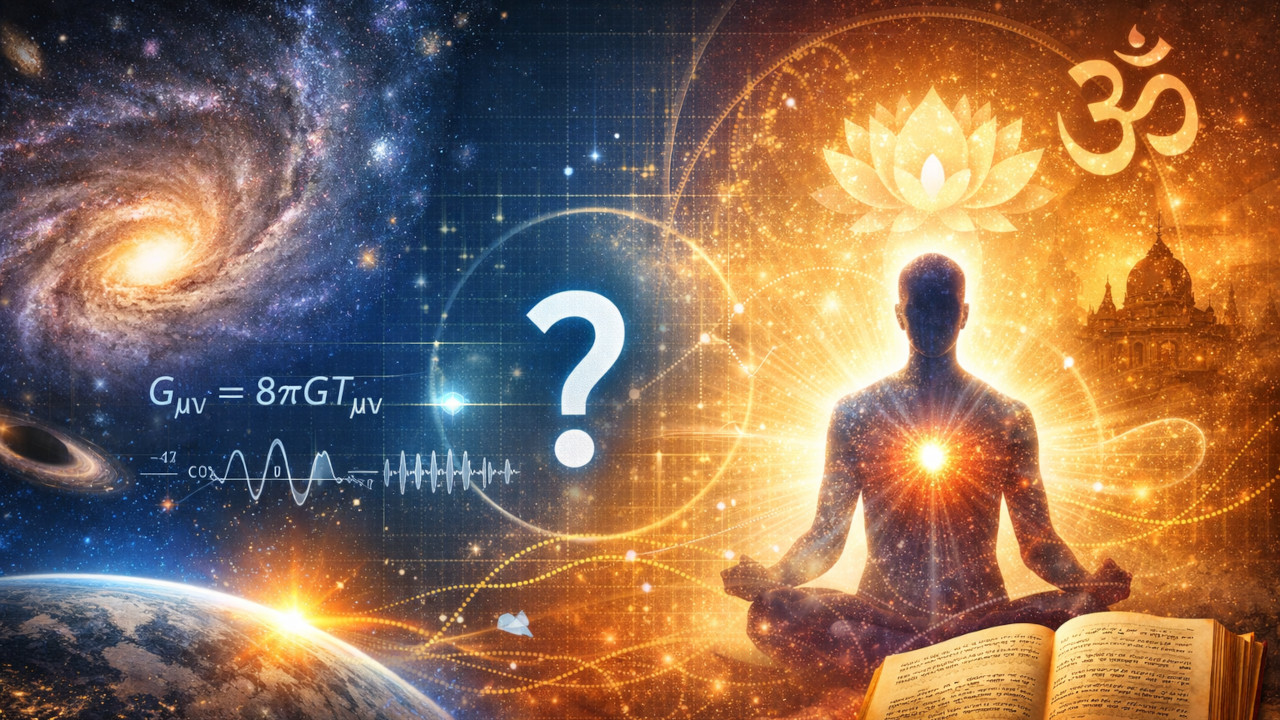
Adam Frank’s Atlantic article, “The Truth Physics Can No Longer Ignore,” points to a real shift underway in contemporary science. For a long time, physics treated living systems as a secondary concern, assuming that the deepest truths about reality would be found by reducing everything to particles and forces. Frank argues that this confidence is now weakening. Life does not fit neatly inside the old reductionist story, and the effort to explain it is forcing physics to revisit assumptions that have shaped the field for centuries.
Frank’s argument begins with an honest observation. A living organism is not simply a thing made of matter. It is a process that persists through continual change. The atoms in your body are replaced over time, yet you remain recognisably yourself. Life looks less like a machine assembled from parts and more like an organised pattern maintained through time. This already creates difficulty for traditional physics, because the reductionist approach is strongest when the object of study is stable and passive.
He then moves to the deeper point. Life is self-organising. Cells build and preserve their own boundaries. They regulate internal conditions. They respond to the environment in ways that support continued existence. Frank highlights the cell membrane as a vivid example. It is both produced by the cell and necessary for the cell’s ongoing life. The system sustains itself through loops of organisation that are not easily captured by simple, linear cause-and-effect models.
From there, Frank turns to emergence and complexity science. He draws on the idea, associated with Philip Anderson, that “more is different.” When many interacting parts form a whole, new properties appear that cannot be predicted from the behaviour of the parts alone. This is a meaningful corrective to simplistic reductionism. It also helps explain why life proves so resistant to being treated as merely complicated chemistry.
Frank presses further by pointing to something he regards as uniquely striking about living systems. Life uses information for its own ends. Organisms detect signals, interpret them in context, and act in goal-directed ways. Plants grow toward light. Microbes move toward nutrients. Animals hide, hunt, nurture, and explore. Human beings reflect, plan, and create. Frank’s point is that this kind of purposive information use seems unlike anything else in the physical universe.
From the perspective of the Ātma Paradigm, this is where the conversation becomes especially important. Frank sees life forcing physics to confront agency. We agree! Agency points to an experiencing subject. Purpose points to a centre of awareness. Information only matters when it is known, interpreted, and valued. When science describes life as using information for its own purposes, it is already circling the reality of subjectivity.
This is also where many conventional explanations begin to thin out. Physicalism often leans on ideas like chance, randomness, or emergence when it reaches questions about mind, meaning, or inner experience. These terms can describe patterns, but they often avoid the core issue. Why is there experience at all? Why is there something it is like to be a living being? Complexity science can map organisation and behaviour, yet it does not automatically account for awareness. Information processing can be measured, but subjective life is not captured by those measurements.
The Ātma Paradigm begins from a different starting point. It treats consciousness as a fundamental property of reality. This is not an attack on science. It is an attempt to correct a philosophical restriction that has been treated as mandatory. The framework respects empirical research while questioning the assumption that consciousness must be produced by matter. From this view, living agency becomes more intelligible. The presence of goal-directed behaviour and meaningful response fits naturally within a consciousness-based account of reality.
Frank’s article also touches on artificial intelligence, and this is another place where the Ātma Paradigm offers clarity. Frank suggests that understanding life is essential for understanding intelligence and for evaluating claims about machine consciousness. That is a sensible direction. The risk in the current cultural conversation is that impressive performance is taken as evidence of inner experience. Systems can mimic aspects of human language and reasoning without possessing awareness. A consciousness-first framework keeps the distinction clear. Behaviour can be simulated. Subjective experience requires a subject.
The Ātma Paradigm proposes a model in which the brain functions as an interface through which consciousness interacts with the physical world. This approach aligns with neuroscience by taking brain activity seriously, while also accounting for why subjective experience remains difficult to locate within neural mechanisms alone. It also explains why increasing computational complexity does not automatically produce a conscious self.
Frank concludes with a hopeful vision. He expects physics to continue exploring its traditional domains, while also expanding into the study of life, information, and agency. The Ātma Paradigm welcomes that expansion and suggests the next step. A deeper science of life will require a deeper account of mind. If the self is excluded from our basic picture of reality, the hardest problems will remain unsolved or will be managed through placeholders that sound explanatory but do not truly explain.
Physics is beginning to recognise that reductionism has limits. The study of life is one of the strongest reasons why. A consciousness-based framework offers a way forward that remains rational, science-consistent, and open to testable applications. It also restores something that many people intuitively know to be true. Experience is real. Meaning is real. Purpose is real. A worldview that can hold these together with scientific understanding is not a retreat from reason. It is a widening of reason’s scope.