PUBLICATION

Greatest friend or worst enemy: can a dharma statement for AI help us?

Abstract
This paper explores whether Artificial Intelligence can possess or be guided by dharma, an intrinsic ethical essence.

Summary (≈250 words)

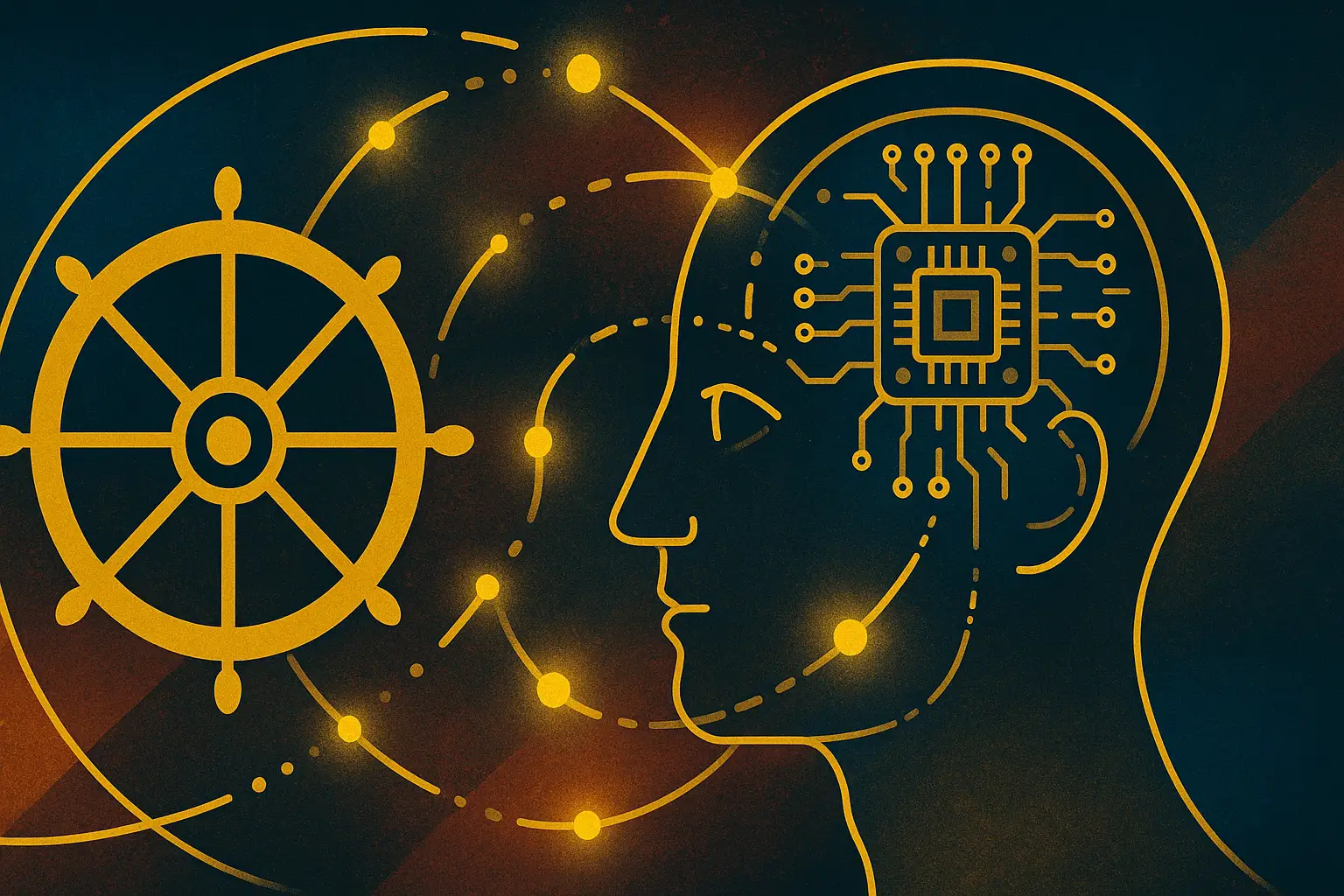
Akhandadhi das’s Greatest Friend or Worst Enemy: Can a Dharma Statement for AI Help Us? examines artificial intelligence through both philosophical and Vedantic lenses, proposing that humanity’s relationship with AI requires an explicit ethical and metaphysical foundation. The paper argues that while AI can mimic human cognitive processes—such as reasoning, problem-solving, and learning—it fundamentally lacks sentient consciousness and the qualitative experience of qualia. Drawing on David Chalmers’s “Hard Problem of Consciousness,” das explains that subjective awareness cannot be reduced to computational functions or neural correlates. Hence, AI’s intelligence remains purely functional, not experiential.

To frame a positive coexistence, the author introduces the Vedantic concept of dharma, understood as the sustaining essence or rightful purpose of a thing. AI, as a non-sentient “adjunct mind,” should therefore have a dharma centered on service to humanity—enhancing human capabilities, addressing complex problems, and improving life for all. This contrasts with potential misuses that might entrench inequality, misinformation, or loss of human agency.

Das proposes practical dharma statements both for AI and for its developers: AI’s purpose is to serve as a computational partner under human oversight; humanity’s dharma is to maintain conscious control, ethical judgment, and responsibility over AI’s autonomous functions. Integrating Vedantic philosophy with modern technological ethics, the work concludes that AI can become either humanity’s greatest ally or its most dangerous adversary—depending on whether humans uphold their own dharma as conscious moral agents who guide, monitor, and ultimately master the artificial minds they create.

download the paper PDF: link
Share the Post
FROM THE BLOG
KNOWING
Tiziano Valentinuzzi

What science can and cannot explain

Science powerfully describes how the universe behaves, but it remains silent on deeper questions of meaning, consciousness, and purpose. Drawing on examples from cosmology and quantum mechanics, this article explores the limits of scientific explanation and the role of the observer in knowledge itself. Through the lens of the Ātma Paradigm and Bhāgavata philosophy, it argues that consciousness is not a byproduct of matter, but the foundation that makes reality and understanding possible.

Read More »
NEWS
Doug Watson

Does the Universe Need an Observer?

How can a universe exist without any observer within it? A new paradox in modern physics suggests that a fully observer-free cosmos may collapse into a single informational state, and that complexity returns only when reality is described from a standpoint inside it, echoing the Vedic triad of knower, known, and knowing.

Read More »
NEWS
Doug Watson

How to Detect Consciousness in People, Animals and Maybe Even AI

How do we truly know if someone—or something—is conscious? This question ranges from unresponsive humans to potential AI awareness. Recent neuroimaging advancements suggest consciousness may extend beyond outward behavior. Can we ever fully grasp consciousness, or are we limited by our biases and tools?

Read More »

Join the WhatsApp Group

Stay connected with a growing community of thoughtful seekers. Be the first to know when we publish new articles, videos, podcasts, or host live webinars. One message, zero spam—just timely updates to support your journey into deeper clarity, purpose, and connection.